

Taxes Explained
Why do taxes keep increasing? Why does the value of my house keep raising even with no updates to the home? These are some of the common questions I get during this time of year. I will attempt to explain how the tax cycle happens and how a piece of land or home can go up when nothing has been done to improve it.
First of all, the values for homes are set January 1st. Once values have been set, taxpayers have 30-days from their notice to appeal that value. This goes for personal property, real estate and oil. Once all the appeals have been settled, the appraiser reports to the clerk by June 1st the valuation for the county. This valuation is used to set budgets. Budgets are settled in August. The clerk then takes those budgets and sets the mill levy around October. Once the mill levy is set, taxes are generated sometime in November. The taxpayer is then granted a 2nd opportunity to protest the value of the property, also known as a payment under protest. This is a harder time for the appraiser to lower a value due to the fact budgets for each taxing district are counting on the valuation from June. This is why the appraiser requires an on-site visit, and prefers to step inside to make sure the inside matches the outside. Taxpayers are allowed one more time to pay under protest in May when the second half of taxes are due.
Taxation SHOULD be a three-legged stool. The first leg is the appraisal value, the second is budget and finally the third is mill levy. This is a perfect world theory of course, but the three separate legs are needed. What many folks that serve on these boards, councils, etc. don’t understand is that if the value increases, the mill levy could come come down to “balance the stool” even if the budget increases.
For example, the Stockton City Valuation is $6,504,281. This includes personal, oil, houses, vacant land and commercial properties. To find the mills, take the city’s budget of $542,646 divided by $6,504,281 equals .08323. Then multiply that by 1,000 to get the total mills of 83.43 mills.
In another illustration, the Plainville City Valuation is $9,104,827. Let’s say you want to figure up the budget but only have the mill levy of 81.578. The first step is to divide the mills by 1,000 to get the cents per dollar. In this case it would be .081578. Multiply that number by the valuation of $9,104,827 to get the amount of the budget $742,754.
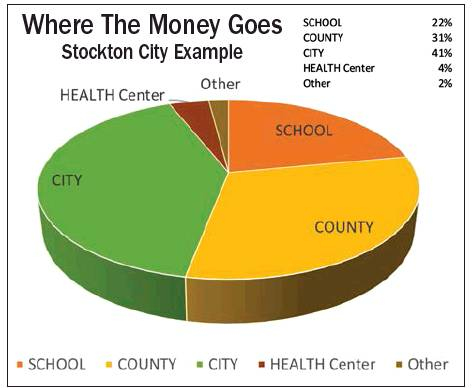
These two instances are just one slice of the pie that is your taxes (see example). There are still the school, county, extension, etc. So, if a board or council decides to leave their budget the same even if the appraisal goes up, it means that the mill levy could go down.
For example, if the house valuation is $75,000 by the appraiser’s office, mill levy from the previous year is 200 mills. The math is simple: $75,000 appraised value times .115 State assessment rate equals $8,625 assessed value times the mill levy of .200 equals a tax estimate of $1,725.
Now, what if that same house sells, or due to other home sales, the value is $120,000. The appraiser, finding market value, goes with $120,000 for the value that year. If the mill levy stays the same the tax bill will be as follows: $120,000 appraised value times .115 State assessment rate equals $13,800 assessed value. Take $13,800 times .200 mill levy to get a tax estimate of $2,760.
By the mill levy staying the same, all the taxing units involved (county, schools, cemetery, fire, etc.) share $1,035 tax increase. Again, the appraiser raised the value to market value. The taxing districts did their job of maintaining the mills and still received more tax dollars. However, it is a 60% tax increase in one year. Now is it the seller’s fault for asking too much for the house, the buyer for paying it, or the budgets that are covering the wages and health insurance of your neighbor? It is not an easy question, however there is not just one office or person involved from start to finish.
Finally, let’s take one more look at this with the value going to market value of $120,000 but this time the taxing districts do not change their budget amount, so the mill levy decreases 75 mills.
$120,000 appraised value
X 11.5% State assessment rate
$ 13,800 assessed value
X .125 mill levy
$1,725 tax estimate
It is the same tax value when the house was valued at $75,000. Of course, this is just one home and the mill levy example are a perfect-world situation. But this is how the tax system was intended to work. If the appraiser’s office dropped all the values in half, one could assume the mill levy would double to cover the budget need.
So, to recap: 1.) Budgets divided by the valuation equals the mill levy; 2.) Valuation is completed January 1st—months prior to budgets being set; 3.) The house value is supposed to be market value or as close as possible regardless of what has been done or not done to the house. 3.) The word “improvement” does not mean something has been done to the house. It represents all structures on the property; 4.) An increase in taxes could mean a change in value, budgets or both. 5.) In a perfect world as values go up,
SO, TO RECAP: 1.) Budgets divided by the valuation equals the mill levy; 2.) Valuation is completed January 1st—months prior to budgets being set; 3.) The house value is supposed to be market value or as close as possible regardless of what has been done or not done to the house. 3.) The word “improvement” does not mean something has been done to the house. It represents all structures on the property; 4.) An increase in taxes could mean a change in value, budgets or both. 5.) In a perfect world as values go up, mill levy should go down if budget stays the same; 6.) Increases in budgets, no matter how big or small, will affect mill levy directly. mill levy should go down if budget stays the same; 6.) Increases in budgets, no matter how big or small, will affect mill levy directly.
The tax system is not easy to understand, which is why there are elected officials. There are many moving parts to it, but hopefully this cleared a few questions up. If not, please feel free to drop by the appraiser’s office or better yet, invite the appraiser to your next meeting.
