

First Congregational Church to celebrate 150 years of faith
Church service and luncheon this Sunday, August 9th
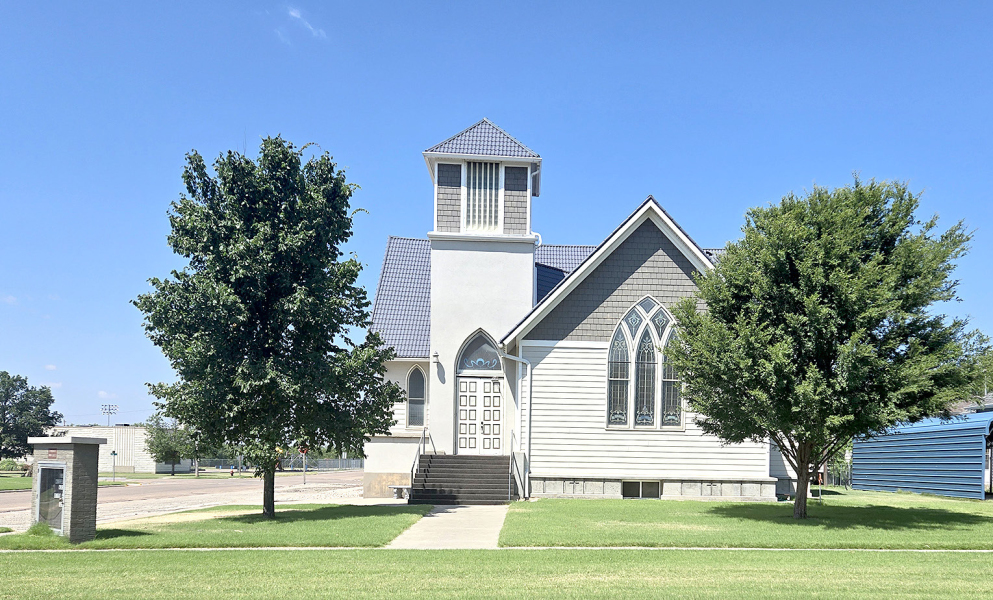
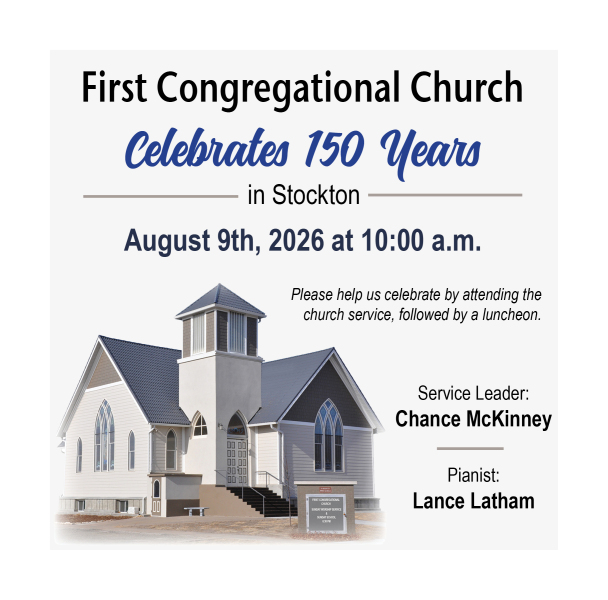
STANDING AS A TESTAMENT TO FAITH, perseverance, and community for a century and a half, the First Congregational Church of Stockton will celebrate its 150th anniversary this Sunday, August 9.The special celebration will begin with a 10 a.m. worship service, followed by a luncheon honoring the congregation's rich history and the generations who have called the church home.
For 150 years, the First Congregational Church of Stockton has stood as a steadfast symbol of faith, fellowship, and service to the community. This Sunday, August 9, the congregation will celebrate that remarkable milestone with a special worship service at 10 a.m., followed by a luncheon, as it reflects on a rich history that began in 1875 with a handful of faithful pioneers and has continued through generations of worship, growth, challenges, and community outreach.
The First Congregational Church of Stockton was the outgrowth of the missionary activities of Reverend R. B. Foster, who had become the minister for the newly established Church in Osborne City. Reverend Foster was occasionally assisted in his preaching by one of the deacons, Colonel W. L. Bear. Then, in 1875, another farmer who lived northwest of Osborne City, J. K. Eckman, took over preaching to the people in the newly established town of Stockton. The Stockton News, the town's first newspaper, in its January 6th edition, announced that Reverend J. K. Eckman 'preaches to our people every alternate Sabbath.' In that same issue of the News, it also stated that preliminary steps had been taken to organize a Sunday School, with Mr. E. Good as superintendent.
The next issue boldly chronicled that the organization of the First Congregational Church in the county had been perfected under the direction of Reverend Mr. Foster. The pastor was to be Reverend J. K. Eckman, and Deacons were E. Good and George W. Patterson. Trustees were John Lauesen and Joseph Roundee. The clerk and treasurer was George W. Patterson.
Church services were held in the schoolhouse, and then, for reasons unexplained, they were held in a Main Street building that had been used as a saloon for a time. At the February 5th, 1879 church meeting, it was voted that 'we form ourselves into a corporation for the purpose of holding the property and attending to the pecuniary affairs of the church.' The goal was for a permanent location, and on April 18th the following year, the cornerstone for the church building was laid with appropriate ceremonies. Reverend R. B. Foster was the speaker for the occasion, and the newly-formed church choir furnished the music.
Reverend R. S. Osborn was the stone mason in charge. At the same time, Deacon Good placed a tin box containing the list of contributors, some coins, and copies of various newspapers and magazines within the cornerstone.
It seemed, however, that the ceremony was just a bit premature from the standpoint of strict legal usage. It was not until April 12th, 1880, that Judge James A. French transferred Lot No. 21 to the First Congregational Church of Stockton. This transfer was made possible by an Act of Congress, passed on March 7th, 18678. In May 1880, the town was incorporated, and lots were assessed to those who had made improvements thereon; this fully explains the early start on the foundation.
In the meantime, Reverend J. Eckman had ceased to be pastor, and in the fall of 1878, a young man, fresh from Yale College, came as a worker for the Sunday School extension service.
He began to preach for the new congregation, and on April 4th, 1879, the letter missive was sent to the churches of Ash Rock, Bloomington, Bull City, Ellis, Hays City, Lowell, and Osborn, and Reverend F. E. Sherman was duly ordained and installed as pastor.
The new Church, as planned, was to be a New England-style church with a steeple seventy-five feet high and a seating capacity of two hundred and forty. The estimated cost was $2,000.00. But due to financial constraints and the committee's inability to borrow $1,000.00, the work was delayed. General business conditions reflected in the subscription list, which circulated among those interested.
Their subscription ranged from 50 cents to $ 25.00.
Then, at last, came a promise of a $300.00 gift from the Board of Church Extension, so it was deemed possible to begin work on the Church.
The building of the Church required the combined efforts of all. The first question was, where would the new Church be built? As early as 1898, there had been talk of a more central location. A committee investigated lots owned by Judge Ham on the corner of Highway 183 and Second Street.
When the vote was taken, however, the majority decided to remain at the old location. So plans for a new church were drawn and the subscription list started. The new building was brick-veneer with a pointed steeple. Work progressed well; by June 23rd, 1907, it was ready for the dedicatory services. The total cost was a little over $8,500.00.
The period following the building of the Church was a prosperous one, with the outstanding debt liquidated within a few years. The Christian Endeavor Society had a very active program. New members were added annually, and the high point for the forward movement seemed to be during the ministry of Reverend B. F. Buck, 1912-1919. Then came World War I, and the young men from the Church were drafted into the Army. As many as twenty-one, including two sons of the minister, were taken.
It was doubtful whether the Church ever fully recovered from the wartime slump. The Church seemed to have lost some of the verve of former years, and perhaps part of the difficulty lay in the loss of the old-time stalwarts.
Either by death or removal to other places, those who worked so persistently for the Church had gone.
There were Deacon Good, George Stewart, Dr. G. P. Ainsworth, W. L. Chambers, A. D. Hemmingway, Mr. and Mrs. John Reed, Judge and Mrs. C. W. Smith, Mr. and Mrs. M. J. Coolbaugh, and Mr. and Mrs. E. J. Williams. Those had all been a mighty power in the Church.
Then in the music department there had been Fannie Budd, Fannie Donnel- Nehr and her parents, Laura Lyons Tuttle, Mrs. M. J. Patterson, Mrs. G. P. Ainsworth, Mary Tarbell, David B. Smyth, Mrs. W. L. Harlan, O. O. Osborn, Edna Pierce Hawks, Judge and Mrs. C. W. Smith, and Mr. and Mrs. E. J. Williams.
Fortunately, there were still those willing to do their part. New faces were found in the old places, and work moved along.
All went well until the Depression of 1930 struck. In 1935, after the departure of Reverend Frank Gonzales, the Church remained without a minister until the arrival of Reverent O. T. Meador in July of 1938.
Plus, the Church retained some of its old-time spirit through the pastorate of Reverend John Nolan, who remained until the beginning of 1944. Then there was a period of inactivity, and to escape the encumbrance involved, the parsonage was sold for $3,500.00. It wasn't until 1947 that new life started up again in the old Church. Robert Osborn seems to have been one of the movers, with others like Frank Smith waiting for someone to get things started. Mrs. Muriel Olson was then secured as a preacher for a few Sundays at Easter time, and in November she became the regular minister of the Church.
Mrs. Olson seemed to be the tonic necessary to revive interest, and soon a program of renovation and remodeling was underway. In the plans was a new parsonage just west of the meeting house, with about $8,500.00 in subscriptions raised. The Church was redecorated, the old pulpit was removed, and a chancel was added with brass candlesticks and a brass cross. A Hammond electric organ was given in memory of Judge and Mrs. W. B. Ham by Mrs. Ham's sisters and a niece. Then, on February 20th, 1949, there was a rededication service.
Dr. Samuel M. LePage came in on October 1st, 1949, and his energetic wife proceeded to build on a foundation already laid. The attendance and interest in the church services grew apace until the Ladies Guild, with Mrs.
Eva B. Smith as president, moved that the Church arrange a pageant and services to celebrate the Church's 75th anniversary, a motion that was carried unanimously.
The Church is its people, and since 1950, the Congregational Church continued to grow and prosper with stalwart pastors: Dr. Samuel LePage (1949-1954), O. T. Meador (1954-1966), and James H. Williams, who arrived with his wife, Grace, in 1967. He also served the United Methodist Church in Woodston, was the Stockton Rotary Club President, and was active in the Chamber, the Ministerial Alliance, and the United Fund Drives.
There were only three clerks who served during 1950 through 1975. They were Stanley Krysl, Irma Renner, and Freddie Baughman. The organizers were Beryl Towns, Pauline Meoder, Barbara Osborn, and Hilda McClellan. The treasurers were Edith Lee, Ada Hughes, Helen Hornbrook, Eloise Berkley, and Mary Mason. The Sunday School Superintendents included Jessie Hammond, Nora Marshall, Clara Mullen, Frankie Dillingham, Lucia Hamilton, and Grace Williams.
Trustees elected to serve during this time period were John Towns, Lucia Hamilton, J. W. McMillen, Bernard Carlson, Robert Osborn, Leighton Marshall, Harold Brown, Mall Mullen, Robert Dickey, Jack McMillen, Cora Long, Roy DeRosear, Wayne McCaslin, Pryce Hurley, Marion Larson, Harry Griffin, Leon Hamilton, C. E. Kingensmith, LeRoy Doty, Bill Korb, Don Dix, Kirk Bigge, Stanley Krysl, Freddie Baughman, Perry Russ, Ralph Johnson, Dale Dean, Kenton Casad, Cleo Baughman, Von Scarrow, Ralph Hornbrook Virgil Olson, Dean King, Freeman Sander, Robert Hamilton, James Berkley, and Harvey Riffe.
The Sunday School was briefly disbanded, but the Church worked together and reestablished it. Those responsible for its success and served as teachers were Rosette LePage, Pearl McMillen, Jessie Hammond, Mattie Eshler, Mrs. John Renning, Minnie Totten, Clara Mullen, Frankie Dillingham, Lucia Hamilton, Betty Osborn, Marcella Smith, Frances Nichols, Mabel McCaslin, Pryce Hurley, Robert Osborn, Althea DeRosear, Roma Smith, Nora Marshall, Pauline Meador, Lorene Hurley, John B. Smith, Bessie Dix, June Meador, Judy Sander, Grace Williams, Stanley Krysl, Rose King, Eloise Berkley, Alan Stewart, Robert Schirer, Mary Ann Norton, and Gertrude Peacock.
One of the Sunday School projects for several years after the Korean War was to send monetary gifts to the orphanage there.
The generosity of many members and friends of the Church, through memorials and bequests, supported that project, as well as the general upkeep of the building and grounds. The Sanctuary received new lights, carpeting, and pews. The walls were paneled, and the choir room was made into the minister's office.
Air conditioning, a new organ, and a new piano were also installed.
In 1961, the Church joined other denominations to form The United Church of Christ. Still, it retained its original name, First Congregational Church, which was known for its art auctions, bazaars, church dinners, St. Patrick's Day Coffees, food sales, and soup suppers.
For the Centennial celebration, the church ladies compiled a Centennial Cookbook featuring their favorite recipes, historical information, and original artwork. Another Centennial project was a picture quilt that Judy Sander designed with actual photographs of historical places and local people, which were transferred onto blocks.
Deaconesses and Deacons who served from 1950 to 1975 includeded Mrs. George Siegel, Cora Long, Mary Wells, Mary Roelfs, Hannah Eckman, Ada Hughes, Roma Smith, Helen Hornbrook, Hazel Larson, Wren Denio, Edith Lee, Winifred Low, Beulah Behrens, Clara Mullen, Pearl McMillen, Ellen Mc-Cauley, Bessie Dix, Norva Doty, Myrtle Baughman, Mabel McCaslin, Opal Hamilton, Eva B. Smith, John B. Smith, Harold Brown, Stanley Krysl, Ralph Nornbrook, Robert Osborn Leighton Marhshall, Duffie Hindman, Thomas Bixby, Roy Nichols, Matt Mullen, John Towns, Cleo Baughman, E. P. Mason, Dean King, Jack Berkley, Bill Korb, Freeman Sander, Robert Schirer, and Leonard Dix.
From 1976 to 2001, the Church faced difficulties due to declining rural populations, with declining membership and tight budgets. But during the tenure of Jane Ireland and her suggestion of an Endowment Fund, which was approved in 1992, it grew beyond anyone's expectations. Bernice Brown left 80 acres and their mineral rights in 1998, before the land was sold three years later. Despite a seemingly continual decline in membership over the years, the Church did seem to turn a corner in the 1990s, with the Endowment Fund continuing to grow and work on the Church in the early 2000s, giving it a fresh new look. Other positive things included the Sunday School and Confirmation classes becoming more active, and an adult Bible study class held on Sundays.
The Church also provided the Weekly Bread gathering of students during Wednesday noon hour, with young people from all denominations in attendance.
But sadly, during that time the Church lost a handful of members who were instrumental in keeping the congregation going: Robert Osborn, John B. Smith, Wayne McCaslin, Stanley Krysl, and Roy Nichols.
In the early 2000s, positives for the Church included landscaping beginning on the west side of the Church and the hiring of a Church coordinator for the Sunday Services. Mendy Schlaegel was hired for the position while the Church searched for a minister after Pastor Jolene Stephenson left in July of 2003.
The new pastor, Reverend Vince Williams, was hired in 2005. He also served as the minister of the Main Street Christian Church.
When a large tornado passed over Stockton in June of 2005, it didn't touch down low enough to damage buildings or structures around town, but it did blow out the Church's largest stained-glass window on the south side. In December, the Church received a generous endowment from the Pearl McMillen Trust. During this time, the Church decided to replace the roof and install protective windows on the outside of the stained-glass windows. Ministers serving the Church from 1976 to the early 2000s were Reverend James H. Williams, Dr. William L. Osborne, Mrs. Muriel Olson, Robert J. Achor, Julie D. Tipton-Rendon, Jane Ireland, Janet Wieblen, Christian Tierre, Gary Peters, Patricia Ault-Duell, and Jolene Stephenson.
From 2010 to the present, the Church has undergone maintenance projects, including exterior brickwork done by Cornerstone in 2012. Grants were applied for, and fundraisers such as garage sales were held to help meet the Church's needs over the next few years, with additional exterior maintenance and stonework done in 2014. Also, working on increasing member numbers was a focus.
Georgeann Peck was the pastor during this period, and the Church also decided to hold morning-hour services in the summer and evening-hour services in the winter.
In 2016, the Church's pastor was Blair Kirkpatrick. The Church helped with the Bible study at Solomon Valley Manor once a month. Nancy Becker assumed the duties of church coordinator from Mendy Schalegel, and also set up a Facebook page for the Church.
In 2020, the pastor situation was changing, and the Church was visited by the Christian Church to arrange to see whether Pastor Bob Matthews would hold worship for the congregation.
In 2021, the Church had to purchase a new HVAC system. Sunday services were held in the basement, which had a separate unit, from July to September of that year while the new unit was installed. Other minor updates were also completed.
In March of 2025, a special meeting was held to ask Gary Huntley to serve as pastor. Now, Chance McKinney has been in the pulpit two Sundays a week, while others with a message to share stand before the congregation during the other Sundays of the month.
Some of the Trustees since the 1980s have included James Berkley, John Berkley, Iva Lee Mc-Millen, Cary Tucker, Keith Schlaegel, Darrell Latham, David Baughman, Thomas Bigge, Bob Hamilton, Don Hamit, Bart Hamilton, Don LaRue, Delbert Sander, Don Wieden, Michelle Wieden, Dale Winklepleck, Lucille Scott, Susan Schneider, Jonathan Berkley, Vicki Berkley, Edward Hageman, Chris Kollman, Mary Mason, Linda Brungardt, Betty Osborn, Ginger Kollman, Harvey Riffe, Freeman Sander, Jeff Iman, Pam Hageman and Debra Dix.
The 150th anniversary celebration is at 10:00 a.m. this Sunday, August 9th, with Chance McKinney as the service leader and Lance Latham as pianist. A luncheon will be held following the church service.
