


Rescue The Plainville Times’ linotype
By Roger Morris, Rooks County Historical Society Board Member
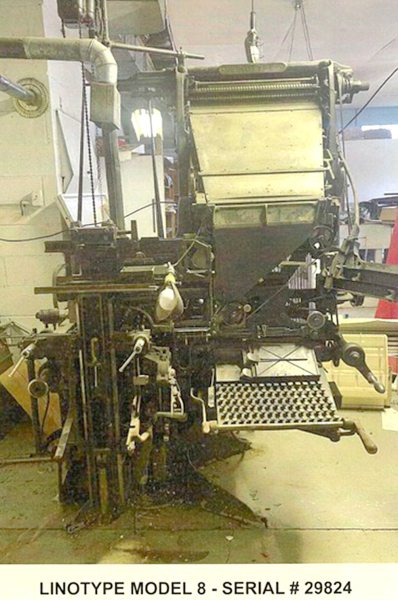
The Linotype, once known as the 8th Wonder of the World, was invented by Ottmar Mergenthaler. At 18 years of age Mergenthaler emigrated to the United States from Germany in 1872.
By 1884, he had invented and patented the first Linotype, the most revolutionary advance in printing since 1450.
The word “line-of-type” derives from the fact that the Linotype machine produces an entire line of metal type at one time.
The Linotype revolutionized the printing industry by eliminating the slow process of setting type by hand. Before the Linotype letter-by-letter of a line was set manually byhand.While the Linotype is called a type-setting machine, it is really a composing machine.
The Linotype operator at a keyboard enters textsassembling a line of matrices (small brass units having characters indented in the edges), which are molds. The matrices are formed into a line and then are moved to a mold where lead is injected.
The assembled line of text is cast as a single piece, known as a slug or a lineof- type and is then set by hand.
Before the installation of the Linotype, the Plainville Times used a Unitype typesetting machine which was purchased in 1914. The Unitype typesetting machine was the first of its kind brought to northwest Kansas.
After the Linotype was installed, the Plainville Times sold the Unitype to the Ransom Record inRansom, Kansas.
In June 1920, a Kansas representative of the Linotype Co., New York City, was in Plainville. The publisher of the Plainville Times placed an order for a new $5,000.00 Model 8 Linotype typesetting machine. In June 1921, the Model 8 Linotype was installed at the Plainville Times. The Plainville Times was one of the first newspapers in northwest Kansas to acquire a Model 8 Linotype. This Linotype was the finest typesetting machine in northwestern Kansas and it became the standard nationwide for typesetting until the late 1970’s and early 1980’s.
The Plainville Times purchased a used Model 14 Linotype in the 1960s.
This Linotype machine, according to its serial number 46143 was built in the early 1920s and saw its first service in the Capperpublications plant setting type for the Topeka Daily Capital-Journal.
A revolutionary change in the method of typesetting adopted by the Plainville Times in 1975 made the Model 8 and Model 14 Linotypes obsolete although during the transition years they were used as “back ups” just in case the new computerized typesetting equipment failed to function properly. Both the Model 8 and 14 Linotype machines were used to publish the Plainville Times until the early 1980s. As the use of the Linotypes became less and the demand for more space at the Times office Harlan Lill, Times editor, made the decision to junk the Model 14 Linotype.In 1982, veteran newspaperman and Times shop foreman Tom Allen, in his 55th year “on the job” meticulously disassembled the Model 14 Linotype. The Model 8 Linotype was not junked and remains in the former Times office at 400 West Mill.
Newspaper publishers throughout the United State retired Linotype typesetting machines during the 1970s and 1980s replacing them with phototypesetting equipmentand later computerized typesetting and pagecomposition systems.
When publishers stopped using the Linotypes they were junked and sold as scrap metal. Very few Linotypes are on display in museums.There are no static Linotype displays in western Kansas. However, Crawford County Historical Society in Pittsburg, Kansas, has a Model 14 Linotype on display.
As of 2022, Linotype newspapers are gone in the United States, fully extinct except for the Saguache Crescent, a small publication in southern Colorado. Each week the publisher uses a Model 14 Linotype to compose and prepare lines of type.
To prevent the Model 8 Linotype from becoming scrap iron, the Plainville Times has offered to donate the Model 8 Linotype to the Rooks County Historical Society/Museum. The Linotype is a very large and heavy machine.
The machine is 84 in. in height, 57 in. in width and 48 in. in depth. The machine’s weight is close to 2000 lbs. The plan is to move the machine from the former Times office in one piece and transport it to the museum in Stockton. A large opening in the formerTimes building on west Mill must be made to move the Linotype in one piece. Prior to removal a dolly to set the machine on must be fabricated. The estimated cost to move the Linotype to the museum and to display it is $5,000.
The Rooks County Historical Society/Museum is willing to accept the Linotype donation from the Plainville Times should the museum secure the funding necessary to move the machine.
For more information about the “Rescue the Plainville Times’ Linotype Project” contact Roger Morris at 785-737-6010 or by email at rogerdeanmorris@ gmail.com.
Visit the Rooks County Historical Society/Museum’s booth located in the 4-H building at the RooksCounty Fairgrounds.
