

Kenneth Glee Cooper: Barber by Trade and the “Cooper Barber Shop”
Stockton, Kansas
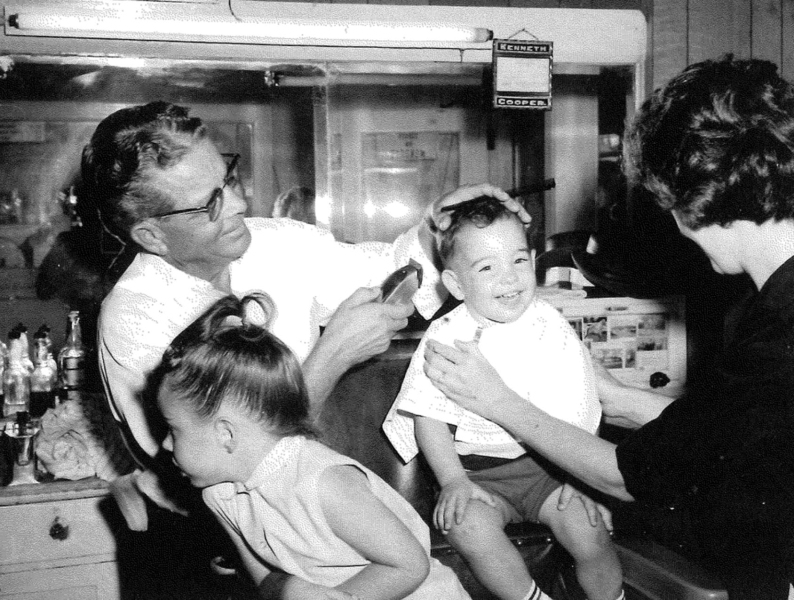
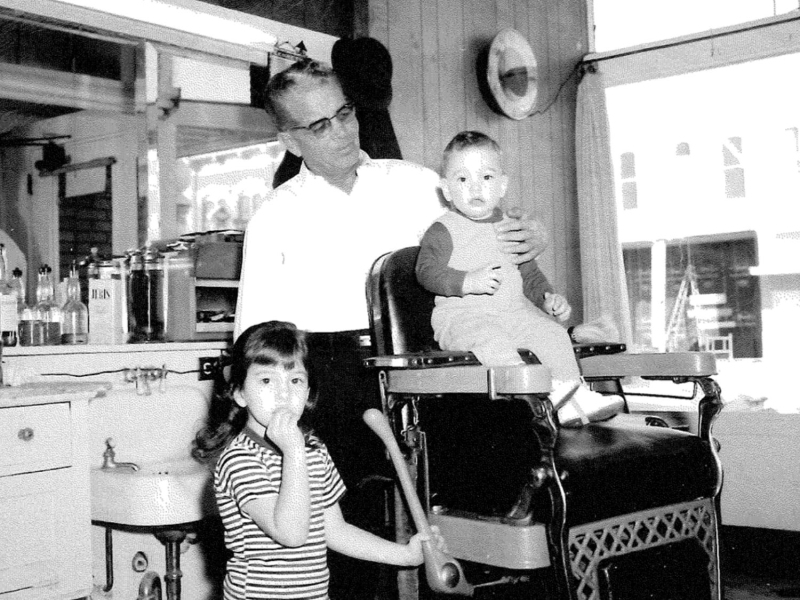
This story about the Cooper Barber Shop, that served the men and boys of Stockton for 48 years, was written by Jeral G. Cooper, a Stockton alumnus who lives in Tonganoxie.
My father was my best friend and my special education teacher. He taught not only me, but also many other young boys, how to sit still and not to move while he was cutting their hair. Quite often these first timers were terrified of losing their locks. They were screaming, yelling, kicking and trying to get ahold of their mothers or fathers in order to make their escape from the barber’s chair.
Not going to happen. My father, Kenneth Cooper, had his hand right on top of their heads, holding their stiffened-up torsos to the board stretched across the chair’s arm rests. Some mothers also shed a tear or two when those long curls slid down the apron onto the shop floor.
I’m pretty sure the haircutting profession started long before Delilah cut Sampson’s hair, but Kenneth Cooper started his barbering career at the end of his sophomore year. He quit high school and became an apprenticed barber in Woodston in 1924. Then he met Ada Smither, and suddenly high school transcended barbering. They both graduated from Woodston High School in the Class of 1927.
Kenneth moved to Westmorland where he barbered in a shop there as “first chair.” Ada began teaching grade school at a country school north and west of Woodston. Kenneth and Ada were married on November 4, 1927 during her spring break. Ada continued teaching for the remainder of the school year while Kenneth moved to Lucas and bought his first barbershop there in early 1928 from Jim Byers. This apparently was not a success story as it did not last very long, and he and Ada moved to Chanute where Kenneth went to work for a Mr. Brown for $20 a week. This didn’t work too well either, as Kenneth had the “second chair” and Mr. Brown had the “first chair.” The first chair normally does the most business. It may have depended somewhat on speed and talent, too. But $20 a week?
Kenneth then went to work for Charlie Tice in the Oriental Barber Shop. He and Ada lived above the barbershop.
My father had been raised as a Quaker. He had accepted Christ at the age of eight and was baptized in a creek. While in Chanute, he became acquainted with the Christian Church minister (who he really liked), and he joined the Christian Church, where he and Ada became very active in church work.
Ironically, Ada’s sister Eva and her husband Albert Howland were living in Chanute at this time and Albert was pastoring a United Brethren Church there.
Buys barbershop in Stockton
My mother and father had several very nice, lifelong friends in Chanute, but they were not happy about being so far from family and former friends. So it was no surprise that in 1930, when Ada’s father (W. T. Smither of Woodston) heard of a barbershop that was for sale in Stockton, Kenneth took flight and hightailed it up to Stockton and bought that shop.
This shop was in the west side of the Kielholtz building, located on Main Street. And it was a three-chair shop! I believe he did retain two other barbers for a period of time, and then over the years, off and on, he’d have a third chair barber. Although there were other barbers over the years, I only remember a few of them: Jess Rife, Olliver Crowell, Jimmy James, Orville Livingston, Carl Moore and Bob Lambert.
When I say he bought the barbershop, he bought three barber chairs, wall mirrors on the back wall, three sinks with running water, towels and aprons, three individual towel-and-tool cabinets with marble tops, and a full-length shelf for hair oil and tonics. There were three tall, round, green “dirty towel” cans (one for each barber). Individual folding chairs were along the front wall and two chairs were up front in the window area.
There were three overhead fans that operated by one electric motor and three leather belts. So it was an “air conditioned” barbershop! Maybe you buy goodwill,
Maybe you buy goodwill, too, if some of the barbers stay on and old customers keep coming back. This particular shop was a real barbershop. Right out of the wild, wild west days with a big copper bathtub and three shower stalls with heated running water. Baths with soap and towels were furnished for 35¢; Haircuts were 35¢; Shaves 25¢; Shoe Shines 10¢; and Boot Shines 20¢ (if you shined or saddle soaped the uppers). This became the first “Cooper Barber Shop.” There was a little building—for customer use only—attached to the Kielholtz building that was always padlocked. It was the toilet, with running water! This was a rare amenity that not all businesses provided for their customers, and you had to ask for the key. I still have that key, but the accommodations are long gone.
I remember my father’s agony and some customers grumbling the day my father raised the price of haircuts in his shop to 50¢ and shaves to 35¢. But all the barbers in town, except one, had agreed to the raise. That was in the 1940s. I believe there were five barbershops in Stockton at that time.
The barbershop in those days-gone-by was where men gathered, just to sit in the windowseat in order to watch others walking up and down the sidewalks or watch the vehicles being driven through town on Highway 24, our Main Street. Some would read the paper for the news or maybe they wanted to tell you their news. Some guys are listeners and some guys are the news and storytellers.
As the barber’s son, shoe shiner and barbershop janitor, I learned a lot about the patrons of the Cooper Barber Shop. I have many fond memories of the great men of Stockton. Two of the best storytellers I’ve ever heard frequented the barbershop nearly once a week. One was the Congregational Church Minister, O. T. Meador. He would tell a funny joke or story, one after another. You’d still be laughing after he left the shop. The other was Ira Hazen, the auctioneer. His jokes or stories were sometimes a little “off color,” but funny. I just loved these guys and still think about them and what great men they were. They were storytellers and “pillars” of Stockton.
Relocates to 415 Main
The “Cooper Barber Shop” was in the Kielholtz building from 1930 until 1947 when they moved to 415 Main from 1947 until July 10, 1979. My granddad, Tom Smither, bought the building housing the PlaMor Pool Hall and Floyd Fleming Barber Shop at 415 Main Street in November 1946 for $2,750 and sold it to my father the same day for $3,750.
In the spring of 1947, my father had the facade and the old wooden front removed and a new brick front replaced it. The Cooper Barber Shop was in the east side and my mother’s Miniature Fashions clothing store was in the west side. (This building currently houses the Rooks County Abstract and The Cutting Edge.) The PlaMor moved across the street, and Floyd Fleming moved his barbershop a block east and to the north side of Main Street. My memories of the
My memories of the Cooper Barber Shop are from all the nostalgic experiences I had. These memories were of the men of Stockton that frequented the shop. The guys that just came in every day to loaf, read the paper, watch other people on the street, smoke a cigarette, cigar or pipe, tell or just listen to stories or jokes. Some would relive hunting and fishing trips of the past and their upcoming expeditions in the making. And then there were actual customers, too.
Saturdays were the busiest and the longest working hours for barbers. I’d often stay late and ride home with Dad (three blocks).
On two different occasions, I have memory of a poker game scheduled for after closing hours. Neither of these games were for poker only. These were strategic planning sessions by the fearless woodsmen. These guys were seated cross-legged on the floor with cards, chips, ash trays, cigarettes and beer bottles. The curtains were drawn. I’d be laying down in the third barber chair, the guys were maybe six feet away. My observation point was perfect.
The conversation was all about the dates, times, equipment, provisions, groceries, lodging and transportation.
The fishing trip was to Colorado, and the hunting trip was in Nebraska (as I remember). The biggest obstacle always seemed to be how they were going to break the “good news” to their wives. Truth be known, their wives probably already knew and had their own plans already made!
I do have some pictures of their fishing and hunting skills. Pictures of fish, deer, ducks, pheasants and rabbits. These are the camera-picture proof of the stories that were told and retold in the Cooper Barber Shop.
In years since, I’ve heard of similar tales in other barbershops. So I know all the other stories I’d heard have been true and factual. They had to be... because men don’t lie about important stuff like that!
I believe my father had a real, deep passion for barbering, enjoyed his customers and was truly a skilled barber... my unbiased opinion.
He had a small, metal suitcase which he carried to homes, nursing homes and to the Hays Hospital. It contained his hair clippers, combs, a brush, scissors, small bottles of tonic, talcum powder, a shaving mug, soap, a straightedge razor, small strap, and an apron. He made hospital and house calls for his customers and friends. For some, it was their last haircut or shave.
He invented, or made, a sharpening wheel for straightedge razors and scissors. I know he sharpened a lot of scissors for the ladies in Stockton and surrounding towns. Kenneth built one for the first water-cooled air conditioners in town for his barbershop. Then he built one for our home.
I believe my father, Kenneth Cooper, barbered for 53 years, and 48 of those years were in Stockton, Kansas, where I had the privilege of working at the Cooper Barber Shop for nearly twelve of those years as the janitor and shoe shiner.
These were impactful years in my life, and I know that the close association with those who I consider to be the most important and most dominant men in my life are and forever will be etched in my memories of the Cooper Barber Shop.
If you are still young enough (or old enough) to remember those three long oak benches that were in the Cooper Barber Shop, they were original furniture from the Stockton Courthouse. I still have two of them. I also have the shoe-shine stool. It had been a shoe-fitting stool from the J.C. Penney store, and my father installed a shoe stand on it so I could shine the customers’ shoes while they were getting barber work done. I have several of his barbering tools and the tool set he carried. My nephew has the barber pole that hung outside the shop and several of his razors and a shaving mug. I have the three oak, towel and tool cabinets from the original Kielholtz shop and many more nostalgic memories.
But the Cooper Barber Shop is forever gone.