

Learning to know the Martins: America’s most wanted bird
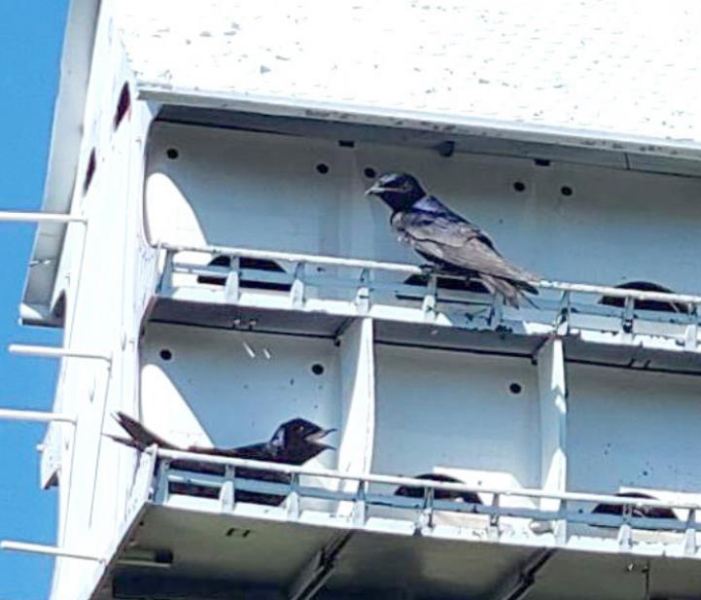
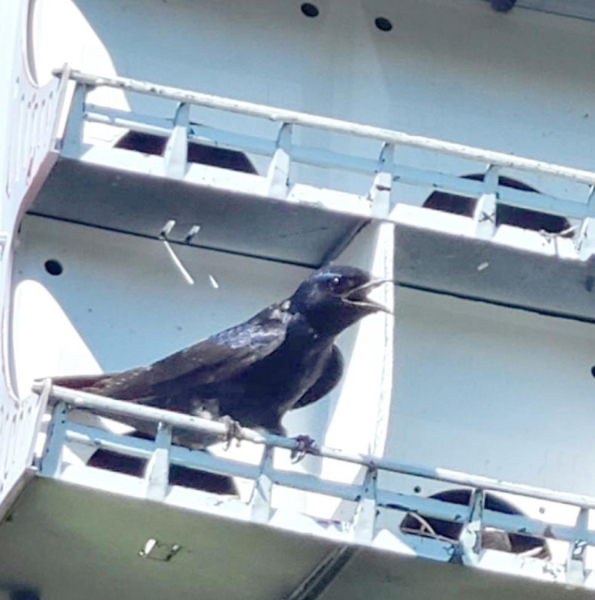
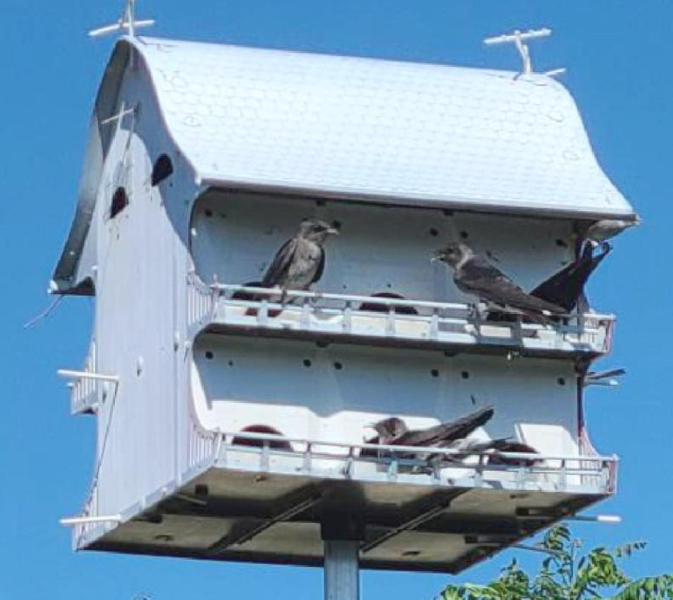
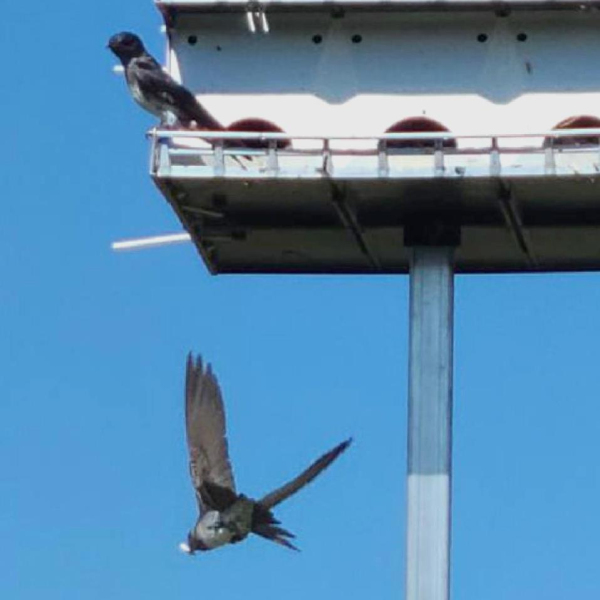
While on an evening walk with my two-year-old spanador, Charley, a few weeks ago, we were on our usual route on South 2nd Street when we came upon a very busy neighborhood. It wasn’t busy with people, mind you; this back yard was all aflutter with Purple Martins—swooping, gliding, diving, flapping, rising—and it was noisy with screaches and “zweeeets” and “tchewwew.” These martins were having a hey-day as they were loading up on any insect that dared to enter the area.
Most of you have probably figured out that I was at the home and back yard of Don and Jane Cunningham, where three large martin “condominiums” rise probably 12-15 feet into the air. That evening, the Cunninghams happened to be out in their yard, as well, so Charley and I stopped by to visit with them.
I was totally captivated by the birds, and of course, so was Charley. While doing my best to hang on to her, I was able to visit just a little bit with Don about the martins and the three nesting boxes he has in their back yard. It was fascinating. Don told me so many things about the birds, about their habits and the wonderful things they do, how far they travel to get here, and demonstrated how he raises and lowers the nesting boxes, which I call “condos.”
Charley was not allowing me to comprehend much of what Don was saying because she wanted to chase the birds, but I wanted to learn more about them. So I told Don I would like to come back again and visit with him, perhaps even do a story for the newspaper. I don’t think he took me serious.
When I returned a few weeks later, I sat down with Don in their kitchen and had him start at the very beginning and give me a lesson on Purple Martins.
Don and Jane moved to Stockton in 2006, and there was a Purple Martin nesting box in their back yard. He said it was a mess having not been cleaned for who knows how long and overrun by birds other than martins. Don knew the martins are popular for keeping the mosquito population down in a yard, so he decided to give it a go. He first gave the nesting box a good cleaning and did some repairs, and then did some homework to learn about the martins and their habitat.
That was then, and now Don has three condos and a fourth one, brand new, is in the garage, which he may or may not put up next year.
Each condo has 16 apartments, a.k.a nests—six on each side and two on each end. Those on the sides have an upgrade with porches on which to perch, which also serve as barriers to keep predators away. The two nests on each end of the condo do not have porches. (I imagine the rent for these nests is cheaper than those with porches; don’t you suppose?) The openings to each nest are halfmoon shaped, an opening that keeps the starlings out, but, unfortunately, not the sparrows. Just to spare you from having to do the math yourself, 16 nests in each makes a total of 48 nests in the three condos. That explains why the Cunninghams back yard is busy—and noisy.
But there’s a great benefit to all of this activity: the Cunninghams—and probably a lot of the neighbors on their block—have no mosquitos or flies. The Purple Martin, the largest of the swallow family, is ordained by nature to eat primarily flying insects such as moths, gnats, flies, and mosquitoes. To survive, each bird must consume tremendous numbers of these insects every day. Don told me he has learned that each martin can eat as many as 1,000 mosquitoes a day. I think I need a Purple Martin condominium in my own back yard, in fact, we need legislation that would provide a Purple Martin nesting box for everyone in America!
Don said not only is cold weather a threat to the martins, but extreme heat spells can be deadly, too. There are times when Don will spray water for them to keep them cool. Martins are not attracted to a bird bath. The Purple Martin not only gets all its food in flight, it gets all its water that way, too. It skims the surface of a pond and scoops up the water with its lower bill.
The martins are very tolerant of people, Don said. I was watching them “dive-bomb” all around us as we visited, and Don said he got thumped on the head, just once. For the most part, they don’t mind people at all as long as you stay away from their nests.
I asked Don what he does to winterize the condos, and he said he just brings them down, cleans them out really good, and then there are covers that screw into the box to close up the doors. The poles are “telescoping” so that they can easily be raised and lowered, and they are triangular in shape, which Don explained is the strongest design for a pole—it cannot be bent, even in our strong Kansas winds. Don won’t raise the condo again until early spring, in time for the “scouts” to start coming in.
Male scouts come first and claim their territory, followed by the females that come about two weeks later. Soon the place is alive with chatter, but our unpredictable, and sometimes harsh, spring weather can really be difficult for the martins. Don said that the only time he has seen dead martins is during an unseasonably cold spell in April or early May. During that time, in addition to the cold, it’s difficult, if not impossible, for them to find the insects they need to survive. Sometimes when we’ve had a cold spring, Don has prepared some mealy worms for them, just to supplement what little food they might find on their own.
By instinct, the Purple Martins return to the same nesting place year after year, which is amazing, considering the thousands of miles they fly in their migration. Don believes he has seen some “repeat customers” who return to the Cunningham Condos. I asked him if he has estimated about how many martins they have this year, and he thinks probably 30 or more adults, plus the juveniles that have hatched.
Recently Don discovered a juvenile on the ground, struggling to get up. He gently picked it up and got it to where it was on its feet, perched on Don’s finger. After giving the young bird a chance to take off on its own, which it did not, Don tossed the bird upward, and it took off flying.
When I was watching the martins several weeks ago when Charley and I were walking, I wondered if the martins leave a lot of mess to clean up. That evening Don had lowered one of the condos and was cleaning a sparrow’s nest out of the nesting box, and I asked Don how often he cleans the nesting boxes. He says he cleans the nesting box only when he sees a lot of sparrow activity, but once the female martins are nesting, he does not disturb them. Otherwise, Don says
Otherwise, Don says the martins are a clean bird. They remove waste from the nest in “waste sacs” that they carry away from the nest and drop in open areas. As we were watching, Don would say, “Oh, there goes a poop sac now,” but I would miss it. A few seconds later, Don would see another martin fly away with a poop sac, and I missed it again. I was really excited when I looked at my photos and saw that I had, totally by luck, caught a martin in flight and carrying a poop sac away from the nest! (Yes, I am easily entertained!)
From a book that Don loaned to me, I learned that when the young birds are learning to fly, their parents take them on ever-lengthening training flights in preparation for their migratory flight. In late summer, the birds begin to congregate in what’s called “assembly areas,” usually beside large bodies of water. The martins return to their house and home grounds for part of each day, but they spend their nights and progressively more time each day, associating with the birds in their assembly area. We might easily recognize them during this time as, sometimes numbering well into the thousands, they gather on highline wires or swoop down into ponds.
Don enjoys listening to the martins, especially because they have so many different songs or calls, depending on the time of day. Early in the morning they have a completely different song they sing—a soft warbling sound that he hears only at dawn. Just from my short visit, I know the martins are very entertaining.
At the end of summer, martin hosts are sad to see “their birds” leave. The air is no longer filled with their friendly chatter, and despite the presence of other song and garden birds, the atmosphere seems strangely empty and quiet for several weeks after the martins leave. Jane is hoping to entice some hummingbirds to her beautiful floral garden, giving them something else to watch.
Don tells me, sure, he misses the martins for a while when they leave, because, as Jane adds, “they are the first thing he checks in the morning and the last thing at night.”
Call it what you will: a hobby or natural insect repellant, but I believe Don has a passion for his Purple Martins. And as they continued to dive down over his head while we visited, I think the martins are quite fond of him, too.
