

Anna Schremmer, K-State Research & Extension Family Consumer Science Agent for Phillips-Rooks District #5
Popcorn: An American Original

Anna Schremmer
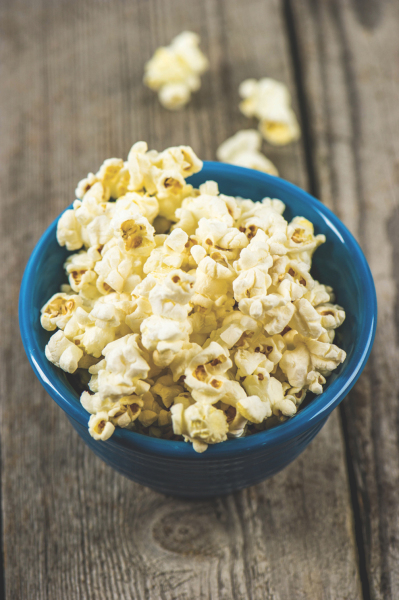
One of my favorite childhood memories was when Dad would get the popcorn popper out and pop popcorn. It was during the winter months and at least three or four times a week. He would find the cobs give us kids one to shell and then start heating the popcorn popper. Dad always would plant a small patch of popcorn so we would have plenty for the winter. He also had a popcorn bowl set, each bowl was a different color. Just thinking about this makes me almost smell that popcorn popping.
Americans consume 17 billion quarts of popped popcorn annually or 54 quarts per man, woman, and child. Some 30% of popcorn is eaten outside the home, including the favorite outside venue movie theatres—but that still leaves a significant 70% eaten in the home.
That’s not surprising since more than 80% of U.S. consumers have a microwave at home. Popcorn also substitutes as a meal for many consumers in a pinch, and some munch on it when they are in diet mode—it’s both low in calories and fat. In fact, one gallon of un-buttered popcorn has a mere 390 calories. A whole-grain food that is high in fiber, protein, and other nutrients, popcorn is one of the healthiest snacks around.
Ever wondered what makes popcorn pop? Popcorn is part of the grain family, its basic components of germ, starch and hull and a tiny amount of water stored inside a circle of soft starch, surrounded by the kernel’s hard outer surface. As the kernel heats up, the water begins to create pressure against the hard starch and expands, forcing the insides to turn out and explode—creating a magic show of sorts.
Here are some “corny” facts about popcorn.
• Most U.S. popcorn is grown in the Midwest, primarily in Indiana, Nebraska, Ohio, Illinois, Iowa, Kentucky and Missouri.
• Many people believe the acres of corn they see in the Midwest during growing season could be picked and eaten for dinner, or dried and popped. In fact, those acres are typically field corn, which is used largely for livestock feed, and differs from both sweet corn and popcorn.
• The peak period for popcorn sales for home consumption is in the fall.
• Most popcorn comes in two basic shapes when it’s popped: snowflake and mushroom. Snowflake is used in movie theaters and ballparks because it looks and pops bigger. Mushroom is used for candy confections because it doesn’t crumble.
• Popping popcorn is the #1 use for microwaves. Most microwaves have a “popcorn” control button.
• How high can popcorn kernels pop? Up to 3 feet in the air.
• In an average bag of popcorn, the number of yellow kernels will outnumber the white ones by 9 to 1.
Snacking is a way of life for Americans. The next time you are peering in the cupboard or looking through the refrigerator in search of a satisfying snack, remember to choose POPCORN.
“Knowledge for Life” provided by Phillips-Rooks Extension District #5 and K-State Research and Extension.
- Log in or Subscribe to post comments.
