

New information emerges on plane crash that took life of Stockton man
Report finds Alaskan State Representative was not legal to fly
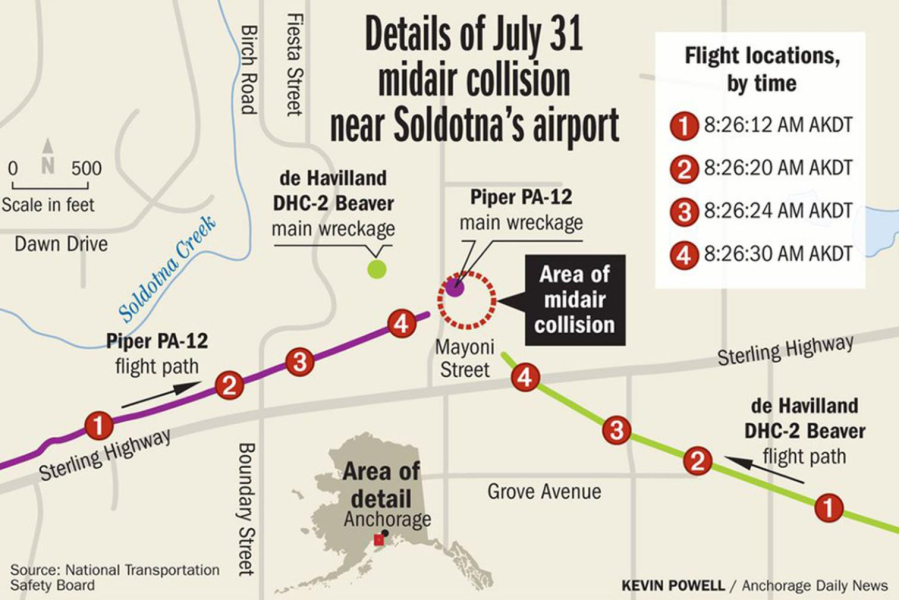
New and disturbing information emerged last week in the July 31, 2020 midair plane crash in Alaska involving two aircraft that tragically took the life of seven people, including David Rogers, age 40, of Stockton.
A preliminary report released from the National Transportation Safety Board showed Alaskan State Rep. Gary Knoff, age 63, of Kenai, was piloting a Piper PA-12 he owned.
The other aircraft, a single-engine de Havilland DHC-2 Beaver operated by High Adventure Air Charter, carried pilot and company co-owner Gregory Bell, age 57, of Soldotna; along with guide David Rogers of Stock-South Carolina residents Caleb Hulsey, 26, Heather Hulsey, 25, Mackay Hulsey, age 24, and Kirsten Wright, age 23.
One person in the second plane reportedly survived the collision but died on the way to the hospital, authorities said at the time.
Now investigators say Knopp was flying despite the 2012 denial of a required medical certification due to vision problems.
The agency has not determined a probable cause for the collision. That finding is more than a year off.
Knopp’s family, contacted earlier this month through a legislative staffer, did not respond to a question asking whether the information about his medical certification was accurate.
The NTSB examination of the crash is considered a “major” investigation and will weigh factors including visibility from both planes and any issues with Knopp’s vision, according to Clint Johnson, the agency’s Alaska chief.
“We want to see if they had the ability to see and avoid each other,” Johnson said.
Other information contained in the NTSB Aviation Accident Preliminary Report by Investigator In Charge (IIC), David B. Banning, reads the floatequipped High Adventure Beaver left the company’s base at Longmere Lake in Soldotna at about 8:24 a.m. for a fishing trip at a remote lake on the west side of Cook Inlet. Knopp, in the other plane, left Soldotna Airport at 8:24 a.m., headed for Fairbanks. The weather at the time was described as calm with high overcast.
The Beaver, carrying 6 passengers, was flying northwest at about 1,175 feet and gradually climbing as it crossed above the Sterling Highway, according to NTSB investigator Brice Banning. Knopp’s Piper was traveling northeast at about the same altitude, north of and parallel to the highway.
The planes collided about 2 1/2 miles northeast of the airport. A witness told investigators he saw Knopp’s Piper hit the Beaver’s left side, toward the back of the plane, causing the left wing to separate.
The damaged aircraft “entered an uncontrolled, descending counterclockwise spiral before disappearing from view,” Banning wrote. The witness lost sight of the Piper.
The report also addresses a subject of confusion immediately following the crash, when the Federal Aviation Administration incorrectly described Knopp’s plane as a twin-engine Piper Aztec despite witness accounts to the contrary.
A registration card inside Knopp’s plane correctly described it as a Piper PA-12 with the corresponding registered “N” number, according to the report. But the plane’s tail carried a different “N” number that corresponded to a number Knopp had reserved for an Aztec that was “deregistered” and not valid.
The word “EXPERIMENTAL” was also applied to the inside of the lower clamshell door, the report states.
Banning found Knopp was denied medical certification by an FAA Alaska region flight surgeon in June 2012, according to information on file with the agency’s Civil Aeromedical Institute. The denial was appealed and sustained in July 2012. The report doesn’t specify what vision problems Knopp suffered.
Without that certification, Knopp was not legal to fly.
According to FAA records, Knopp was a flight instructor who renewed his license earlier this year and also held a commercial pilot license. The FAA registry does not show a medical certificate indicating he had passed a physical exam necessary for flight. Bell’s does show such a certificate.
An FAA spokesman confirmed Knopp did not have a current medical certificate and said certified flight instructors needed one, too.
Bell was part of a local family that owned the Soldotna-based charter company. Rogers, from Stockton, who spent his summers in Alaska working as a guide, was married and the father of three children. Caleb and Heather Hulsey were married in 2019. Wright was Mackay Hulsey’s girlfriend of 10 years. The two Hulseys were brothers and all resided in the Spartanburg area.
Last week, High Adventure Air declined to comment on the NTSB report.
The company stopped flying for several days after the collision and returned to active flight status on August 4th.
Neither airplane was equipped with, nor were they required to be equipped with, a crashworthy flight data or cockpit voice recorder. Several avionics components and personal electronic devices were recovered from the wreckage areas. These components and devices were shipped to the National Transportation Safety Board Vehicle Recorders Laboratory, Washington, D.C., for further examination.
In concluding Banning’s report, a detailed wreckage examination of both airplanes is pending.
(The above story was taken in part from the August 25, 2020 Anchorage Daily News and written by Zaz Hollander)
