

Total solar eclipse to cross North America on April 8
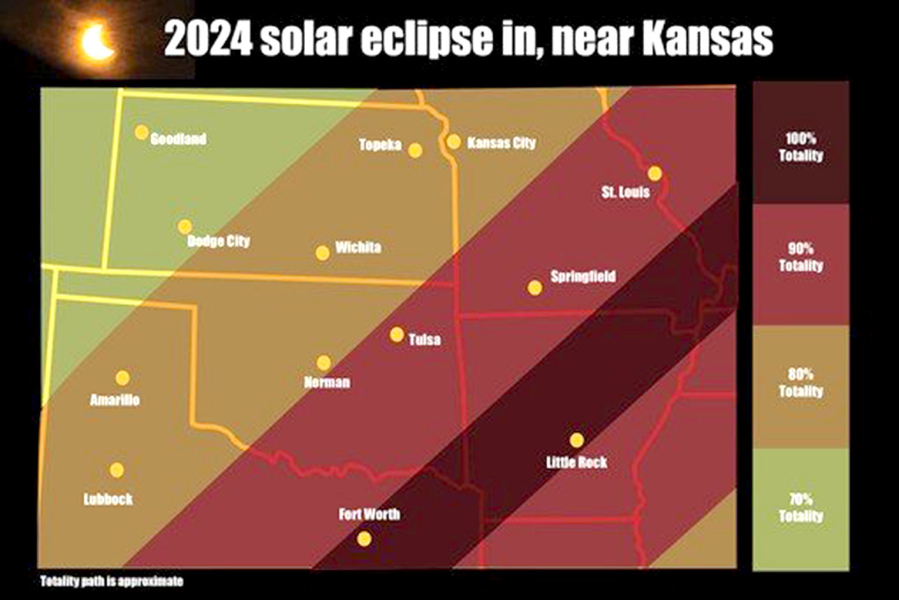
On Monday, April 8, a total solar eclipse will cross North America. The Kansas Department of Transportation and the Kansas Highway Patrol advise travelers to plan ahead as traffic is expected to increase.
“Remember that the shoulders of highways and interstates are for emergencies only,” said KHP Capt. Candice Breshears. “Finding a safe and secure location to view the eclipse is a must for all travelers to make it to their destinations safely.”
Travelers should be patient, avoid distractions and practice safe driving habits.
“Pay attention to the roadway, not the sky,” said KDOT Director of Safety Troy Whitworth. “Be on the lookout for other drivers who may be distracted. Traffic will most likely be heavy before, during and after the event in the locations where the eclipse can be viewed. So, plan your travel accordingly.”
Kansas is not in the direct viewing area of the total solar eclipse. It will begin in Mexico and enter the U.S. in Texas, and parts of 14 additional states will experience the total solar eclipse as it travels northeast across the country. Then it will enter Canada.
According to the National Weather Service, a total solar eclipse occurs when the moon’s elliptical orbit is towards its minimum distance from Earth, making the moon appear larger than the sun. This allows the moon to completely obscure the sun, and a shadow is cast on the Earth’s surface.
Use specialized eye protection to view the sun during this time. Check the weather and plan accordingly – make sure to dress properly and be prepared for potential weather incidents when driving long distances. For information on Kansas road conditions, go to www.kandrive.gov or call 5-1-1.
In the United States, totality will be visible through the states of Texas, Oklahoma, Arkansas, Missouri, Tennessee, extreme northwestern corner of Lake County, Illinois, Kentucky, Indiana, Ohio, Michigan, Pennsylvania, upstate New York, northern Vermont, New Hampshire, and Maine with a line of totality going almost directly over the states highest point, Mount Katahdin. The largest city entirely in its path will be Dallas, Texas.
This will be the second total eclipse visible from the central United States in just seven years, after the eclipse of August 21st, 2017. Totality will pass through the town of Wapakoneta, Ohio, the home of astronaut Neil Armstrong, the first man on the Moon.
This eclipse will be the first total solar eclipse to be visible in the Provinces of Canada since February 26th, 1979, and the first in Mexico since July 11th, 1991. This is the only total solar eclipse in the 21st Century where totality will be visible in Mexico, the United States, and Canada. It will also be the last visible eclipse in the Contiguous United States until August 23rd, 2044. The final solar eclipse of the year will occur six months from now, on October 2nd, 2024.
A solar eclipse occurs when the Moon passes between the Earth and the sun, thereby obscuring the image of the sum for a view of the Earth. A total solar eclipse occurs when the Moon’s apparent diameter is larger than the sun’s, blocking all direct sunlight and turning day into darkness. Totality occurs only in a narrow path across the Earth’s surface, with the partial solar eclipse visible over a surrounding region thousands of kilometers wide.
