

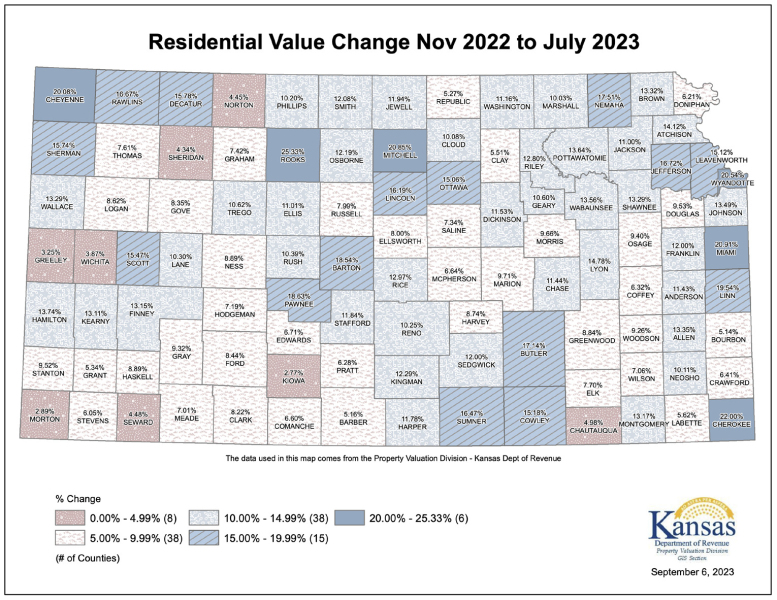
Rooks County residential home values show the most significant increase of all 105 counties in the state
Taxes have raised nearly 50% in the last six years;
a whopping 39.41% over the last two years
November is the time of year when people begin to think of the fast-approaching holidays. However, when residents received their tax statements last week, they were reminded of a disturbing trend Rooks County taxpayers face with continued property tax increases.
In less than a month, Rooks County taxpayers must pay their first-half taxes due on December 20.
More than ever, people are angered by higher property taxes. The majority believe the higher costs associated with increased taxes are out of control. Looking for answers, taxpayers feel helpless and as if their voices aren't being heard.
If you appeal your taxes, you'll likely be given a whole host of reasons why your taxes increased, some of which may include a formula (good luck with understanding that one), a neighbor fixing up his/her property, which in turn raised your taxes, or Johnny or Martha paid an exorbitant price above what a particular property was valued, causing your taxes to go up, etc., etc.
When the latest Residential Value Change from November 2022 to July 2023 was released on September 6, 2023, by the Kansas Department of Revenue, it was revealed that Rooks County showed the single most increase in residential home values of all 105 counties in Kansas—at 25.33%, up from 14.08% the previous year.
To compare, area counties and their increase during the same period are as follows: Norton, 4.45%; Graham, 7.42%; Russell, 7.99%; Phillips, 10.20%; Trego, 10.62%; Ellis, 11.01%; Osborne, 12.19%; and Smith, 12.08 percent.
Looking at the previous five years of taxes and their increase, two counties mentioned above showed similar increases—Russell County at 24.31% and Osborne at 22.27% from November 2021 to July 2022. No other area county showed an increase of over 20%. However, Smith showed two increases—15.00% from November 2021 to July 2022 and another 12.08% from November 2022 to July 2023, while Osborne's residential values jumped 12.19% in the latest figures.
When combining increases and decreases in values over the last six years for these same counties, sadly, Rooks County leads the way with an increase of 48.27%, followed by Smith at 47.61%; Osborne, 42.40; Trego, 33.69%; Phillips, 31.20%; Ellis, 29.50%; Norton, 23.91%; and Graham at 21.03%.
'The last several years, Rooks County has been stepping up gradually, trying to catch the market,' said Rooks County Appraiser Heather Poore.
During the three years from 2019 to 2021, home values in Rooks County increased slightly—2.28% in 2019, 0.75% in 2020, and 3.83% in 2021.
'As the market was growing faster than the appraisals, the appraisals needed to increase more than what was done in the past,' added Poore.
By law, each parcel of real property shall be appraised at its fair market value. The county appraiser's office determines the value by January 1 each year.
Poore added, 'The office does not get any direction from the commissioners on budget needs because as this article is coming out, the appraiser's office is already worldng in the 2024 year, and the 2023 mill rates have not been officially set.' However, our elected officials know what amount of tax money will be forthcoming.
An appraisal value predicts a property's future value if sold based on past sales and current trends. Any inflation, natural disasters, or significant economic crisises, such as COVID, will not influence the values set by the appraiser if it happens after January 1.
Determining the value is only one of three parts of the Kansas tax system. Knowing what you owe in taxes is also determined after figuring out your assessed value (currently at a rate of 11.5% in Kansas) and where mill levies are set.
So, to explain it as plainly as possible, the taxes you pay are based on these three things: 1.) The value of your property (determined by the appraiser); 2.) The assessed value set by the state (11.5% for residential properties, 25% for commercial and industrial properties, and 30% for agricultural land); and 3.) The mill levies set by local elected officials (city, county, and school).
The Kansas statute defines fair market value as how much money a well-informed buyer is justified in paying a well-informed seller in an open and competitive market. The office relies on this information to find the value of properties.
Kansas voters last changed the property tax code in the state constitution in 1992, when the 11.5 rate was created. That change led to homeowners paying 35% of Kansas' total collected property taxes, while commercial and agriculture made up 65%.
The homeowner portion of the pie gradually increased over the years, maldng up more than half, 56%, while commercial and agriculture paid the other 44%.
'The problem for 2023 is that even though value has gone up over the last few years, the mill rate has stayed relatively the same,' stated Poore.
Looldng at Rooks County tax levies over the years, Rooks County significantly raised the mill levy from 2015 to 2016—increasing the rate from 64.211 mills in 2015 to 78.853 mills in 2016. From 2016 to 2017, the mill levy dropped from 78.853 to 69.464. Since the drops in the mill levy in 2017 and in 2018 (from 69.464 to 62.957), the mill levy has increased by over 1.5 mills since 2018.
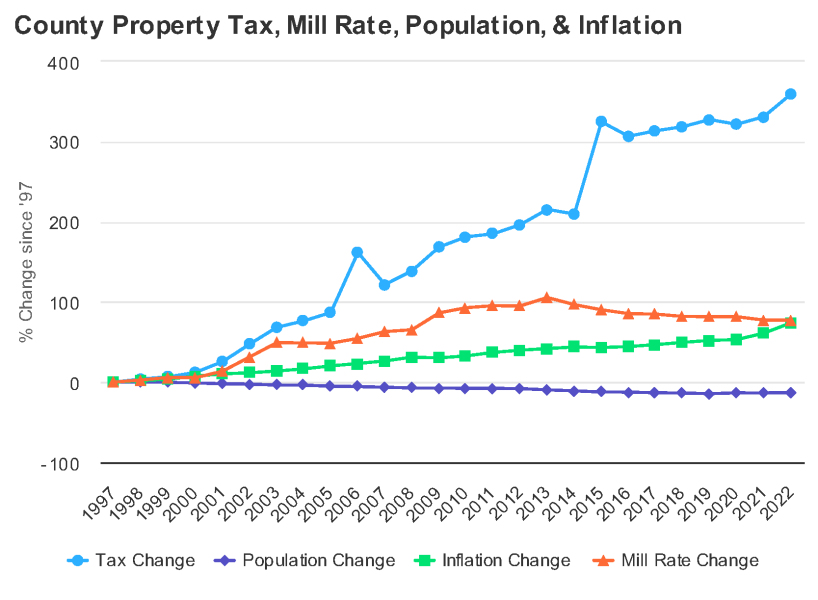
It's easy to understand that even though mill levies have stayed nearly the same since 2018 (when you figure in the 48.27% increase in home values over the last six years), our county elected officials used these tax increases to raise your taxes.
In fairness to elected officials, higher inflation has caused their budgets to expand even to provide the same services their constituents rely on. But, property taxes have risen significantly higher than the rate of inflation.
It's high time people become more involved with how business is conducted. It's time to ask the tough questions to the appropriate parties. Check and double-check what you are told. Wading through a county budget less of what has or has not been done to the home,' concluded Poore.
she right! I've never forgotten that. I loved my mom.'
to find efficiency is hard work. But now is the time to get serious.
'In a perfect world, the theory behind how the State of Kansas does taxes is that the scales are balanced each year. So, as value increases, the mill rate would come down to balance the scale,' added Poore.
Poore emphasized that Rooks County citizens vote for the people maldng and approving the budgets and should attend the RNR meetings to voice concerns.
'If the appraiser's office left all homes at $50,000, the taxing entities would still have to raise the same amount (of money) to meet the budget needs, which means a higher mill rate,' said Poore.
The appraiser's office encourages anyone interested in purchasing property to use the same price as the 'appraised value' to get a reasonable estimate of future property tax estimates, as this is
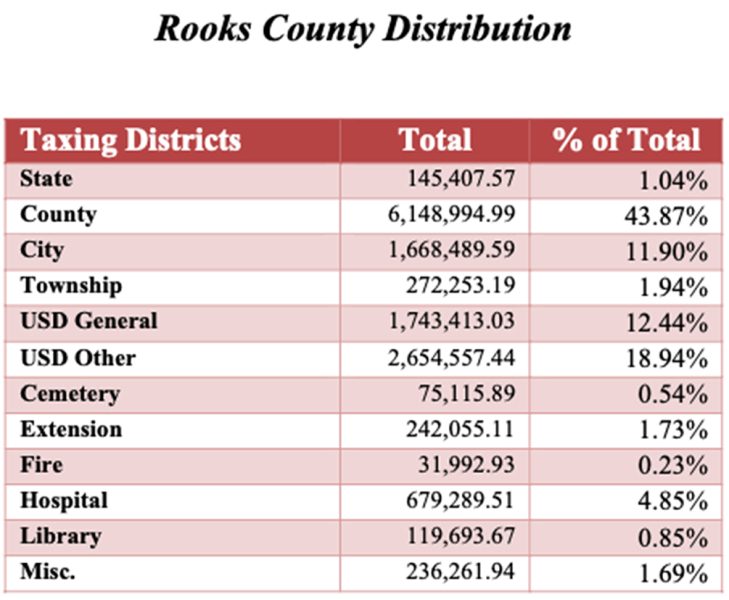
Looking at where property tax dollars are distributed (see chart above) to local taxing authorities in Rooks County, besides just the 1.04% that goes to the state, Rooks County receives 43.87% of the pie, which translates to over six million dollars; the city, 11.90%; Townships, 1.94%; USD General, 12.44%; USD Other, 18.94%; Cemetery, 0.54%; Extension, 1.73%; Fire, 0.23%; Hospital, 4.85%; Library, 0.85%; and Misc., 1.69%.
Shrinking inventories, historically low-interest rates, and the pandemic's impacts all converged to help drive up Kansas property values by double digits in most counties in Kansas in 2020.
But Kansas house prices appear to be correcting in response to the Federal Reserve's aggressive interest hike policy. Buying a house has become much more expensive when considering the interest you will pay on borrowed money. However, interest rates on home mortgages have pulled back slightly in the past few weeks.
Many see the out-ofcontrol property valuations as only beneficial if they're looking to sell a house, which most have no plans to do.
Help From Kansas Lawmakers What will lawmakers do about it? Kansas lawmakers on both sides of the aisle are gearing up for the 2024 legislative session, which reconvenes in January and is expected to make property taxes a dominant focus of the 2024 session, hoping to find some common ground to address rising property taxes.
Kansas has the 14th highest rural homestead property taxes, the highest rural commercial property taxes, and the 3rd highest industrial property taxes in the country.
The Republican-backed plan would cap how much property valuation can increase yearly at 4%. That would hopefully standardize increases for taxpayers and spare them from significant spikes year to year.
The Democratic proposal wants to shift some of the burden of property taxes off of residential homeowners and onto commercial and agricultural real estate. One of their proposals would be lowering the current 11.5% home tax to 9%. However, commercial property and agricultural land would not see a similar reduction.
Neither change would be able to stop local governments from increasing their tax rates. So homeowners could still see a spike in property taxes when their cities and counties raise their mill levies.
How To Figure Your Taxes Here is an example if you want to know what you will pay on your property taxes when you first receive your new values each summer.
• The market value of your home: $60,000
• Statewide residential assessment rate: 11.5%
• The assessed value of your home would be $6,900. ($60,000 x .115 = $6,900)
• $60,000 (Actual Market Value) x .115 (State Residential Assessment Fee) = $6,900 (Assessment Value)
• If the total mill levy determined by the local taxing authorities is 125 mills
• Multiply the assessed value of your property ($6,900) by the mill levy (125 mills or .125).
• The answer is $862.50, which is your share of the total responsibility to support the programs for which the taxes are budgeted.
• $6,900 (Assessed Value) x .125 (Mill Levy) = $862.50 (Tax Amount)
In Closing…
Are our elected officials genuinely making the required tough decision with spending?
Families are struggling, as well as most small businesses. Privately owned businesses have had to find creative ways to cut spending besides the obvious. At the same time, tax-supported entities continue to raise taxes and mill levies if they see a deficit in the money needed. This trend cannot continue, or our communities will die.
If we truly care about the communities in which we live, our way of doing business has to change quickly.
Our elected officials are currently being put on notice. With the most significant residential value increase of all 105 counties in Kansas, will our elected officials do what is right and lower our mill levy before January 1, 2024? The verdict is out.
