

Rachael Brooke, Phillips-Rooks District Extension Agent Agriculture and Natural Resources
Price Risk Management for Cow-Calf Producers
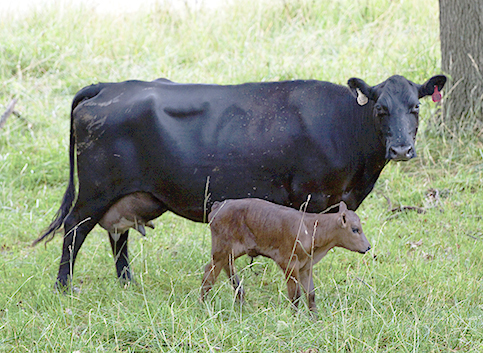

Farmers and ranchers face risk every day. Individual producers have tools to mitigate risk, such vaccination and irrigation, but never have complete control over production outcomes. Price risk is one example of the many types of risk that can influence farm income. “Uncertainty” characterizes a situation where outcomes are unknown, while “risky” characterizes situations where potential outcomes are known or understood, but different outcomes can occur.
For cow-calf producers that are calving now or within the next few months, production (breeding) decisions were made over 9 months ago. However, it will be another 6 months from today, or longer, that most producers receive any income. Predicting market prices at breeding is highly uncertain: it’s difficult to know what markets will be like a year and a half in advance. By calving, market predictions or expected prices for feeder cattle have been established through futures markets: this is a risky situation rather than an uncertain situation. While futures prices are not a guarantee of a particular market price, they provide information about the likely range of price outcomes.
Price risk is not about whether expected prices are high or low, but whether market prices are different than expected. What does it mean for a price to be different than expected? Let’s say a producer calves in April and plans to sell in October. Today October feeder futures are around $185/ cwt. In other words, $185 is the expected market price for October 2022, or $185/ cwt is best estimate we have for average national prices in October, based on currently available information. The price risk faced by the producer is that when October arrives, prices may have dropped below $185/cwt. If prices decrease by October, will the producer still be able to make a profit?
In some years, prices decline or stay the same. The largest decline in recent years was in 2015. In April 2015, October feeder cattle futures were around $214/cwt. By October, prices had declined to around $183/cwt. Some producers might have still made money at $183, but this was substantially less than the expected price in April. Prices were similarly high in April 2014: October feeder futures were over $230/cwt. Actual 2014 October prices were a little higher than this. In 2020 expected and actual prices were also similar, around $140/cwt.
Actual prices can be higher than expected. While this is technically a form of price risk, or “upside risk”, most producers are more worried about price declines, or “downside risk”. In April 2013, the October feeder cattle futures price was around $144/cwt, but the actual price ended up around $160/cwt. Likewise, in 2017, the actual October price was almost $10 higher than expected.
Producers may also face unexpected declines in local prices, that may not be reflected in national or futures markets. This type of risk is often referred to as “basis risk”. Basis risk is defined as the different between the current (or nearby) futures price and local cash prices. For example, prices at the local sale barn may experience a larger decline than futures prices.
To summarize, price risk management is not just about getting a high price; it is about protecting yourself from declines in the expected market price. The next article in this series will discuss different price risk management strategies.
For more information, please contact the local K-State Research and Extension Office. K-State Research and
K-State Research and Extension is an equal opportunity provider and employer. Information provided
Information provided by: Jennifer Ifft, K-State Department of Agricultural Economics
