

Rachael Boyle, Phillips-Rooks District Extension Agent Agriculture and Natural Resources
Harmful Algal Blooms
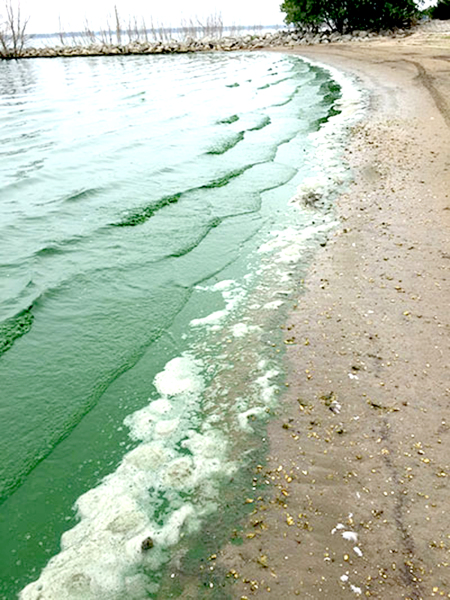
Harmful algal blooms, or HABs, refer to a dense growth of algae with the potential for creating toxins or other nuisance compounds. In freshwater, most HABs are composed of blue-green algae, also known as cyanobacteria. Although blue-green algae are a natural part of water-based ecosystems, they become a problem when nutrients (phosphorus and nitrogen) are present in concentrations above what would naturally occur. Certain cyanobacteria can produce harmful toxins, such as microcystins, nodularin, or anatoxin. Human or animal exposure to or ingestion of these toxins can cause skin rashes, liver and kidney toxicity, nervous system problems, respiratory complications, and even death. Some studies have even suggested that chronic exposure to cyanobacteria may be linked to degenerative diseases such as ALS, Alzheimer’s, and Parkinson’s.
Many factors affect the growth and bloom of harmful algae in lakes and other waterbodies, but weather conditions such as temperature, sunlight, and water clarity are primary contributing factors. Combined with excess nutrients, these factors create conditions favorable for overgrowth of blue-green algae and development of HABs. Blooms usually happen when the right combination of these factors are met, commonly in a hot drought period in summer or early fall, after spring rains have carried fertilizers into lakes and ponds, and when water clarity is relatively high.
While some HABs will have a distinctive look, it is impossible to differentiate between toxic and non-toxic types just by looking at them. Some blooms have an unpleasant odor which can be compounded by a combination of stagnant water, dying blooms, and decomposing organic debris. Blue-green algae are often concentrated on or near the water surface with visible soap-like scums and/or the water appears bright green or blue-green, or even occasionally red or pink. View examples of blue-green algae in Kansas https://www.kdheks.gov/algae-illness/download/BGA_examples.pdf. Anyone can perform a stick test or a jar test to confirm whether a particular algae sample is likely to be blue-green or another type. Use this instruction page to perform jar and stick tests https://www.kdheks.gov/algae-illness/download/Jar_Test.pdf. Otherwise, private waterbody owners who suspect a HAB may wish to have their water tested by a commercial laboratory.
The only known way to prevent harmful algae blooms from occurring is to prevent the conditions that caused them in the first place. Being reactive when a bloom occurs is not enough – it might solve the problem temporarily, but unless you fix the underlying causes, your lake or pond may be very expensive to maintain. To help limit the growth of HABs in community waterbodies follow these recommendations:
Do...
...conduct a soil test before fertilizing your lawn.
...use fertilizers sparingly and appropriately to limit nitrogen and phosphorus-rich runoff.
... create a buffer area around the waterbody with native plants to absorb nutrients from the runoff.
... pick up and appropriately dispose of pet waste.
... regularly test the water quality.
Don’t...
...over-fertilize your lawn, and don’t apply before anticipated rainfall.
...dispose of grass clippings and other organic waste near the waterbody.
...keep the grass too short which attracts geese and other waterfowl.
...feed birds or overfeed fish in the waterbody
For more information, please contact the local K-State Research and Extension Office. K-State Research and Extension is an equal opportunity provider and employer.
- Log in or Subscribe to post comments.
