


Skinners donated Herbaria to Botanical Research Institute of Texas
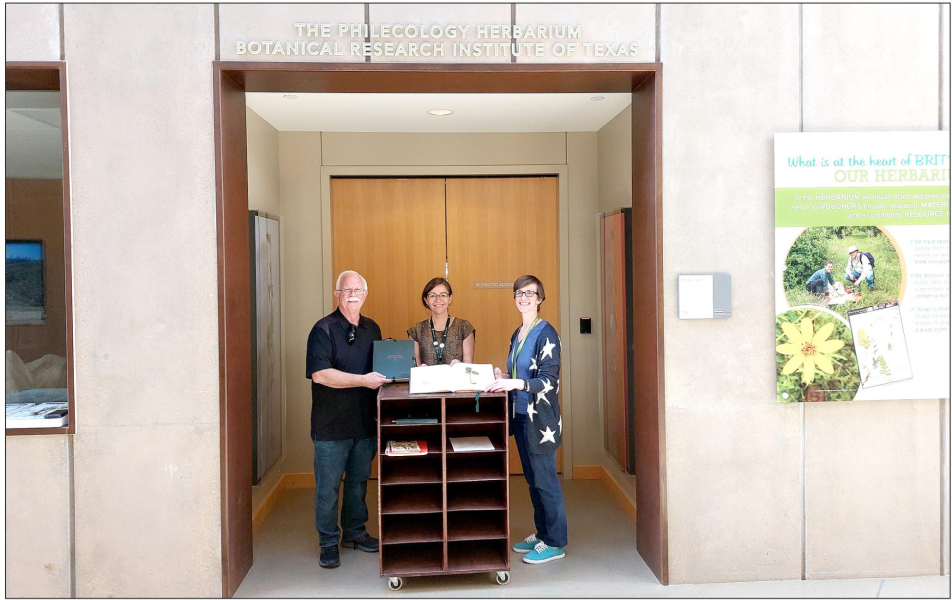
Of the many tasks that Bill Skinner has in retirement, one is the proper disposition of his family’s legacy items; i.e. papers, collections, newsletters, photos, etc. It is a slow process for Bill, but also an enjoyable and interesting task in many ways.
One of the tasks Bill currently worked on was an effort to donate his grandparents’ (William K. Skinner and Ethyl “Betty” McLaughlin Skinner) Herbaria, which is a systematically arranged collection/classification of dried plants native to a particular region, to the Botanical Research Institute of Texas (BRIT). He recently met with Tiana Rehman, the Herbarium Collections Manager for the Phil ecology Collection at the Institute to donate his grandparents’ collection.
Bill’s grandparents were born in 1883 (Ethyl McLaughlin) and 1884 (William K. Skinner) respectively. In their final year of high school (1902 and 1903), each prepared a Herbaria collection of approximately 25 specimens of local flora from the Griggsville, Ill. area. This was a practice more common to that era than it is today. These collections have been in the Skinner family all the years since. Bill’s sister and he remembers them, looking through the books with their gramma Betty (Ethyl) as youngsters. The collections were kept in his grandfather’s barrister bookcase for many years, and later in a file cabinet at Bill’s house. While these aren’t major collections, it showed their grandparents were connected to the natural world. Betty and Judge Skinner enjoyed gardening, loved flowers, hunting and fishing, and the majestic sites of the American West. Some of these traits and passions were passed on to their children. Bill’s sister and Bill have always thought these Herbaria were prepared with a love of the outdoors and done when young William courted Miss McLaughlin. They later married and then moved to Stockton, bringing their collections with them. The Herbaria were a source of conversations and reviewed by many who would visit the Skinners’ residence on North Cedar in Stockton.
Bill wanted to share the information with the Stockton Sentinel. He will now be working with Tiana and her staff to prepare a blog or post to her organization’s website. Tiana indicated to Bill that these Herbaria will be stored and cataloged, perhaps eventually photographed and put online for research. She also indicated that these are perhaps good examples of a practice accomplished during primary/secondary education at that time. In any case, Bill was thrilled to have the opportunity to contribute them.
(The Phil ecology Herbarium (herbarium acronym: BRIT) houses approximately 1,445,000 plant specimens in the combined BRIT, SMU, VDB, and NLU collections, ranking it among the top ten largest herbaria in the United States. Areas of geographic concentration encompass Texas, the southeastern United States, Mexico, Central America, South America, and Southeast Asia. The BRIT herbarium holdings are worldwide in scope, and represent most of the earth’s plant families. Holdings include vascular plants, bryophytes, lichens, fungi, algae, slime molds, microscope slides, and a xylarium.)