


Stockton 7th Graders turn STEAM Project into profitable business, raising $800 for playground equipment

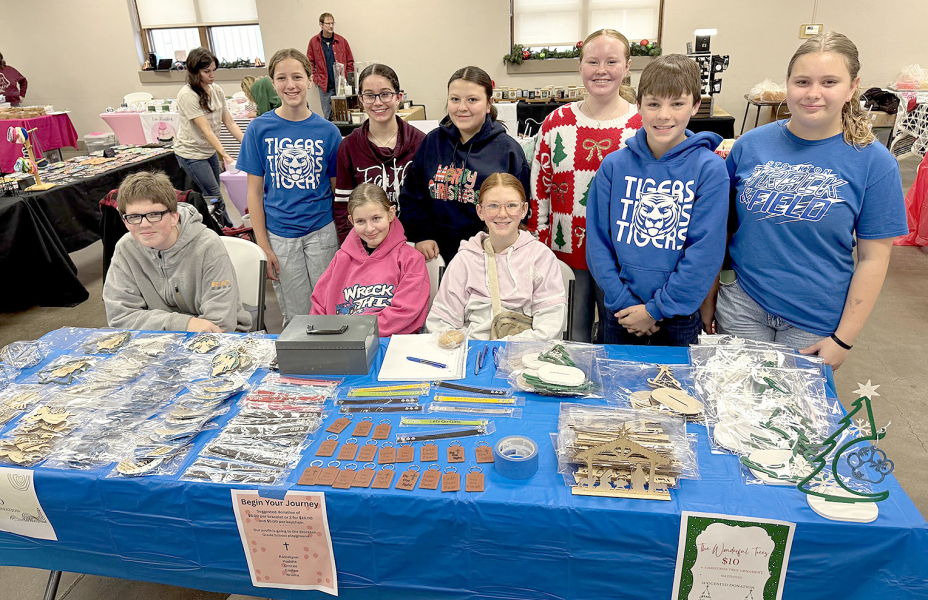
This semester, 7th-grade STEAM (Science, Teachnology, Engineering, Art, and Mathematics) students at Stockton Grade School turned creativity, teamwork, and entrepreneurship into a successful student-run business— one that not only paid off a pretend bank loan but also generated over $800 to support new school playground equipment.
The project began with students forming small-business teams, brainstorming product ideas, and learning to budget for materials. Many groups initially imagined creating tic-tactoe boards, custom bookmarks, or multi-layered wooden ornaments, but quickly discovered that business decisions require flexibility. As student, Vernon Waters, explained, after testing their first ornament design, the group realized their product “took too long to make” and had to pivot to new items such as angels, tiger paws, and Christmas trees Before students could begin production, they visited Farmer’s National Bank to pitch their business plans. They presented spreadsheets, explained projected costs, and requested small “loans”—most teams borrowing between $50 and $65. Students described this experience as eye-opening. 'I learned that it does take a lot of work to get a loan and a decision is not made in one day,' Lily Yohon reflected, noting the importance of preparation and clear communication in business planning. Several students shared that meeting with the bank branch manager, Mr. Reiner, was one of their favorite parts of the entire project. “We talked to the loan officer and learned about loans and interest— it was my favorite,” wrote Maverick Post.
Once funding was secured, production began in full swing. Students worked with the school’s new laser engraver, funded by a Heartland Community Foundation Grant, learned to operate the machine, painted and assembled their products, and solved problems together. Through trial and error, they discovered the importance of quality, consistency, and teamwork.
“I learned that you shouldn’t make a product just because you like it—you should make something lots of people will want to buy,” wrote Grayson Mongeau, who added that running a business “takes a lot of time and effort” and requires staying organized and focused.
Students also reflected on the interpersonal skills they gained. Shoni Jones shared that she learned “even if you and someone else don’t get along, you can still work together,” and that the project improved trust, communication, and cooperation within her group. She also noted how meaningful it felt when groups helped one another meet deadlines: “The bracelet group helped out my group a whole lot…we probably wouldn’t have gotten done without them.”
The project culminated at the community Holiday Mall at Stockton City Hall, where students staffed their booth, interacted with customers, practiced counting back change, and discussed the importance of being present. Many reported that selling their products was both exciting and confidence-building. Shelby Thayer reflected, “I learned how to count back money,” and appreciated seeing the real- world side of business operations at the craft fair. Another noted that working the booth helped build communication skills and taught them how presentation and professionalism affect customers’ impressions.
By the end of the event, nearly every product was sold. Some groups even received special orders after selling out.
Collectively, the junior high students raised over $1,300.00—enough to repay their loans and contribute more than $800.00 toward new playground equipment.
For many students, the project became a highlight of their school year. Kelsey Clayton shared that her favorite memories came from painting ornaments with her group, laughing together, and creating new relationships. “In my opinion, this was my favorite project because we had a fun time and made good memories,” she wrote.
Beyond the financial success, the project left students with practical life skills in budgeting, teamwork, manufacturing, sales, communication, and responsibility. As Grayson Mongeau summed it up: “I learned stuff that I could use when I'm older.”
Story & Pictures Courtesy of Teacher Andrea Dix