


Names on the Wall
By Susan McFarland
Rooks County Museum Coordinator
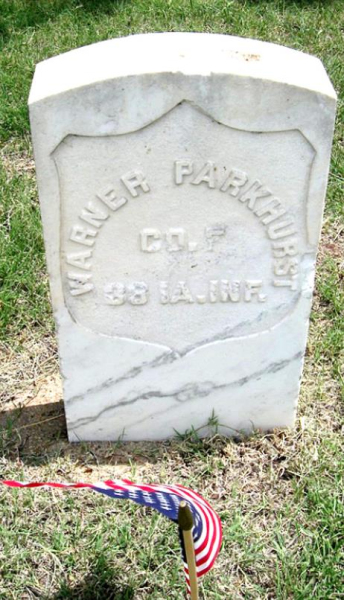
Warner Parkhurst
Co. F, 38th Iowa Infantry Regiment
Co. K, 34th Iowa Infantry Regiment
Warner Parkhurst was born 10 June 1841 in Pennsylvania, eldest child of Charles and Ruth (Hoagland) Parkhurst. In 1860, he lived with his parents and siblings on a farm in Oran Township, Fayette County, Iowa.
During the Civil War, President Lincoln requested more troops from Iowa in July 1862. Parkhurst enlisted in Co. F, 38th Iowa Infantry Regiment on 14 August, and the regiment was mustered into federal service 4 November 1862. They trained at Camp Franklin near Dubuque and were sent to St. Louis in late December. They occupied New Madrid, Missouri, on 2 January 1863 when Confederates departed after burning the military post. The men of the 38th Regiment rebuilt the post. In June 1863, they joined General Grant’s forces at the siege of Vicksburg, Mississippi.
Unfortunately, they were stationed on the edge of a swamp that caused widespread illness and reduced the ranks of the regiment. Nearly one-third of the regiment died from diseases during the war while the number killed in combat was three. During the Civil War, diseases killed about twice as many soldiers as died in battle (the Union Army suffered a total of 110,100 killed in action and 224,580 deaths from diseases).
At Vicksburg, the troops of the 38th Iowa who were able to work dug trenches and rifle pits which provided protection during the siege and capture of Vicksburg, occupied on 4 July. Following Vicksburg, the regiment joined the expedition to capture Yazoo City, Mississippi, occupied on 14 July 1863. They moved on to Port Hudson, Louisiana where many more men were incapacitated by illness. On 13 August the morning report showed only eight officers and twenty enlisted men fit for duty in a regiment that started service with over 900 men. Private Parkhurst was one of those stricken who survived.
The regiment was transferred to a healthier site where the sick men slowly recovered. Some were granted a furlough to return home to recover. Many of those died on the way home. Most of the survivors were considered fit for duty when the regiment started for Texas on 23 October 1863 to join a campaign that brought them into several battles and the capture of Brownsville on the border of Mexico on 9 November. The regiment was stationed at Brownsville for nine months. They left Brownsville on 28 July 1864 and traveled to Mobile Bay in Alabama by steamship.
The regiment performed picket duty during the assault on Fort Morgan, Alabama, which was captured on 23 August 1864. On 8 September they boarded a ship to New Orleans. On 1 January 1865 the regiment was consolidated with the 34th Iowa Infantry Regiment for the duration of the war, thereafter designated the 34th Iowa Infantry. Parkhurst was in Co. K. They encamped near New Orleans until sent by ship to Barrancas, Florida in late January 1865. The 34th Iowa moved to Pensacola, Florida in March, and from there marched to Mobile, Alabama to join the siege where they played a major role in the capture of that city in April. The troops marched to Selma, Alabama and occupied the military post there until 12 May 1865. They returned to Texas and encamped near Houston until sent to Davenport, Iowa where the regiment was mustered out of service on 29 August 1865.
After the Civil War, Warner returned to live with his parents on the family farm near Fairbanks in Fayette County, Iowa. He married Ellen Hoagland on 12 March 1872. They moved to Rooks County in 1878. Warner filed a homestead entry for E½SW¼ and W½SE¼ of Section 14, Township 9 South, Range 17 West, in Twin Mound Township on 27 November 1878 and filed final certification on 11 June 1884. He later purchased another farm in Twin Mound Township that was closer to Plainville, and his son Herbert lived on the homestead. In 1886, Warner built what was called one of the “largest and best barns in the county”—and in February 1887, a strong wind blew down the new structure. Warner sold all his property in Twin Mound Township in 1900 and bought 320 acres located three miles west and five miles south of Plainville. In 1907, he retired from farming and moved into Plainville. His farm sale bill listed 19 horses, 24 cattle, 22 hogs, two truck wagons, one cultivator, a stone band saw, one feed grinder, a sulky plow, four corn harrows, one buggy, one spring wagon, one scraper, two sets harness, two pair flynets, one cream separator, one dinner bell, some woven wire, several dozen chickens and other items.
Parkhurst may have retired from farming— but he kept busy. The Plainville Times (15 June 1911) announced Warner Parkhurst had secured a patent on a three-row corn harrow which he developed to kill small weeds between rows and conserve moisture in the ground. The paper also reported (17 December 1914), “Mr. and Mrs. Warner Parkhurst have a new Studebaker car.” In 1921, Warner and Ellen moved to Hays. Because of health problems, they moved to the Kansas State Soldiers Home at Fort Dodge in 1931. They both died there in 1933 and are buried in the Soldiers Home Cemetery.
Warner Parkhurst had developed three farms in Rooks County and was a highly respected pioneer. On 31 July 1921, when he and Ellen were preparing to move to Hays, a surprise farewell dinner was held for them at the Plainville Methodist Church, with 80 friends attending. The Plainville Times (4 August 1921) noted the Parkhursts had lived in the area “for more than 40 years” and concluded, “It is with the deepest regret that we lose them from our community.”
The children of Warner and Ellen Parkhurst are: Herbert (Bert) (1873-1939) married Esta Sissell (1875-1964) in 1897; Loren Melvin (1875-1960) married Letha Cochran (1881-1964) 24 March 1907; Henry Edison (1879-1925) married Mary Elizabeth McCarroll (1895-1978) 7 May 1903; and Verna (1885-1919), never married and was a victim of the 1919 Spanish Flu pandemic.
